
大宋提刑官
How can enterprises embrace AI transformation? ‘5A Framework’ unveiled_我的网站

一 |
原标题:韩国男子长期家暴中国妻子,还持刀威胁,被判坐牢3年半韩媒报道截图(韩国TJB电视台)海外网9月13日电 据韩国纽西斯通讯社报道,韩国大田地方法院9月11日对一起涉嫌杀人未遂案进行宣判,判处被告人3年零6个月有期徒刑。被告人46岁,受害人是他的中国籍妻子,现年33岁。2010年两人结婚后,被告人经常家暴妻子,曾导致妻子长时间离家出走,并多次提出离婚。韩媒报道截图(韩国TJB电视台)今年6月3日,妻子再次提出离婚,并称“若不同意就报警,举报自己遭到家暴”,被告人当时正在喝酒,听到消息后被激怒,并挥舞刀具威胁妻子。韩媒报道截图(韩国TJB电视台)韩国法官在阐述量刑标准时表示,被告人在吵架时使用凶器,罪行性质恶劣,而且此前也多次实施家暴。受害人即使没有什么经济和社会基础,也一直要求离婚,由此可见她遭受的恐惧和痛苦有多大。 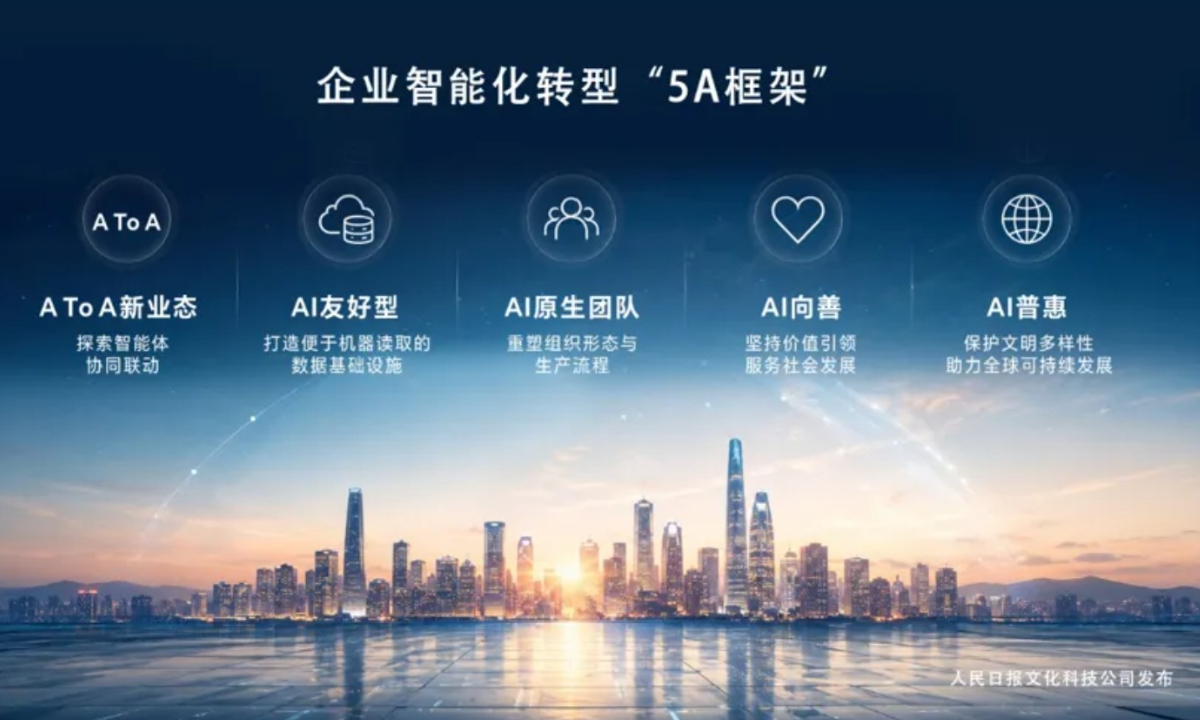
The 2026 Digital Intelligent Economy Forum was held in Langfang, North China’s Hebei Province, on Wednesday. At the forum, organizer People's Daily Cultural Technology Corporation unveiled a “5A Framework” for enterprise intelligent transformation, aimed at helping businesses comprehensively innovate their business models, organizational structures and service systems in the artificial intelligence (AI) era.
A To A: Exploring new models for agent collaboration
AI is pushing the internet into a new stage characterized by the widespread participation of AI agents. In the future, China could develop an ecosystem comprising tens of billions of agent applications, while the global “digital population” could reach hundreds of billions. Following To B (business-oriented) and To C (consumer-oriented) models, enterprises and institutions should actively explore the emerging To A (agent-oriented) model. To enable better interaction and coordination among agents, unified data, technology, interface and service standards need to be established, while new business systems and service models should be cultivated.
AI-friendly: Building machine-readable data infrastructure
Today’s internet user interfaces are primarily designed for human browsing. The first step, therefore, should be to build an “AI-friendly” data system that is better suited to being read, understood and accessed by AI. By structuring content resources and turning them into organized knowledge, while strengthening ontology systems and knowledge graphs, such a system can improve AI’s ability to understand and apply information. On this basis, integrated hardware and software infrastructure combining computing architecture with data systems can be developed for AI applications.
AI-native teams: Reshaping organizations and workflows
AI is profoundly reshaping organizational structures and ways of working. AI-native teams should redefine job responsibilities, organizational structures and business processes around the A-To-A model and AI-friendly services, enabling “everyone to have multiple AI agents.” Professional capabilities and business experience can be encapsulated into “digital employees,” promoting autonomous learning by agents, multi-agent collaboration and the evolution of collective intelligence, thereby multiplying per-capita productivity.
AI for good: Putting values first, serving social development
AI also requires values-based guidance. Guided by the principle of “being people-centered and using AI for good,” efforts should follow the approach of “governing AI with AI and guiding intelligence with wisdom,” ensuring that AI always serves social development, the public interest and people’s needs. The “Mainstream Values Corpus,” whose development was launched by the People’s Daily in May 2023, has already begun to take shape and has been validated through numerous large-model applications.
Inclusive AI: Protecting cultural diversity, advancing global sustainable development
AI should not become merely “a game for rich countries and rich people,” but should benefit all countries. Efforts should be made to actively participate in global initiatives for inclusive AI, bridge the digital and intelligent divide, and enable more organizations and individuals to share the benefits of development on an equal footing, so that AI can truly become a powerful positive force for improving the well-being of all humanity and advancing human civilization.
This was translated and compiled by the Global Times, based on an article originally published on people.cn on August 12, 2026.
。(海外网 刘强)责编:刘强、李萌返回搜狐,查看更多责任编辑:
。The 2026 Digital Intelligent Economy Forum was held in Langfang, North China’s Hebei Province, on Wednesday. At the forum, organizer People's Daily Cultural Technology Corporation unveiled a “5A Framework” for enterprise intelligent transformation, aimed at helping businesses comprehensively innovate their business models, organizational structures and service systems in the artificial intelligence (AI) era.
A To A: Exploring new models for agent collaboration
AI is pushing the internet into a new stage characterized by the widespread participation of AI agents. In the future, China could develop an ecosystem comprising tens of billions of agent applications, while the global “digital population” could reach hundreds of billions. Following To B (business-oriented) and To C (consumer-oriented) models, enterprises and institutions should actively explore the emerging To A (agent-oriented) model. To enable better interaction and coordination among agents, unified data, technology, interface and service standards need to be established, while new business systems and service models should be cultivated.
AI-friendly: Building machine-readable data infrastructure
Today’s internet user interfaces are primarily designed for human browsing. The first step, therefore, should be to build an “AI-friendly” data system that is better suited to being read, understood and accessed by AI. By structuring content resources and turning them into organized knowledge, while strengthening ontology systems and knowledge graphs, such a system can improve AI’s ability to understand and apply information. On this basis, integrated hardware and software infrastructure combining computing architecture with data systems can be developed for AI applications.
AI-native teams: Reshaping organizations and workflows
AI is profoundly reshaping organizational structures and ways of working. AI-native teams should redefine job responsibilities, organizational structures and business processes around the A-To-A model and AI-friendly services, enabling “everyone to have multiple AI agents.” Professional capabilities and business experience can be encapsulated into “digital employees,” promoting autonomous learning by agents, multi-agent collaboration and the evolution of collective intelligence, thereby multiplying per-capita productivity.
AI for good: Putting values first, serving social development
AI also requires values-based guidance. Guided by the principle of “being people-centered and using AI for good,” efforts should follow the approach of “governing AI with AI and guiding intelligence with wisdom,” ensuring that AI always serves social development, the public interest and people’s needs. The “Mainstream Values Corpus,” whose development was launched by the People’s Daily in May 2023, has already begun to take shape and has been validated through numerous large-model applications.
Inclusive AI: Protecting cultural diversity, advancing global sustainable development
AI should not become merely “a game for rich countries and rich people,” but should benefit all countries. Efforts should be made to actively participate in global initiatives for inclusive AI, bridge the digital and intelligent divide, and enable more organizations and individuals to share the benefits of development on an equal footing, so that AI can truly become a powerful positive force for improving the well-being of all humanity and advancing human civilization.
This was translated and compiled by the Global Times, based on an article originally published on people.cn on August 12, 2026.
。(海外网 刘强)责编:刘强、李萌返回搜狐,查看更多责任编辑:
Current article:http://9fq102.tourunbiaodubaicubangninan.shop/list_rhhty54/1igsw.html
Published on:08:42:30